Decarbonizing
Industrial Heating
Decarbonizing Industrial Heating
Electrification of hard-to-abate Industries
The Future of High Temperature Electric Heating.
A sustainable and high-performance alternative to fossil-fuel industrial heating. Sintex HoneyComb is a high-temperature electrification technology developed for integration into hybrid and electrified heating architectures. With it’s integration into industrial heating architectures, the Sintex HoneyComb helps OEMs and system builders introduce high-temperature electrification through hybrid and electrified heating systems that enable significant CO₂ reductions.
Introducing Sintex HoneyComb - Electric Heating
Sintex HoneyComb electric heating elements are based on our world-leading expertise in metal powder extrusion, high-temperature alloys, and our proprietary manufacturing process.
The heating elements are electrically connected and will by the internal resistance reach high temperatures.
Any gas – ambient or specific process gas – will flow through the internal structures and exit the elements dry and free of combustion water.
This is the future of Electric Heating.
Introducing Sintex HoneyComb
Introducing Sintex HoneyComb - Electric Heating
Sintex HoneyComb heating elements are based on our world-leading expertise in metal powder extrusion, high-temperature alloys, and our proprietary manufacturing process.
The heating elements are electrically connected and will by the internal resistance reach high temperatures.
Any gas – ambient or specific process gas – will flow through the internal structures and exit the elements dry and free of combustion water.
Customization and flexibility to fit your application
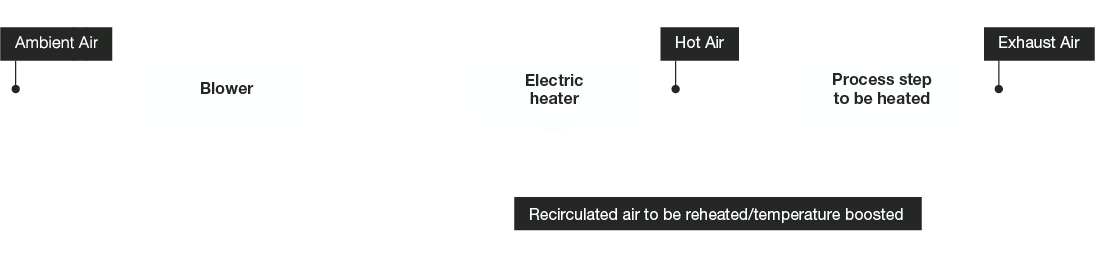
Air
- Air inlet: Air enter the blower
- Blower: Secure high flow rate
- Electric heater: Electric heaters heats the air
- Heating chamber: The product is heated to the process temperature
- Product outlet: The resulting products exit the system
Gas
- H2 enters at around 100°C
- Electric heater heats the gas
- The gas enters the DRI at around 950°C (where iron ore enters and iron pellets exits)
- Water is condensed and removed
- Remaining H2 is recirculated
While the heating element is still undergoing testing, initial results are promising.
Temperatures
Up to 950°C
High Power Output
Game-changing performance in a space-saving design
A twin HoneyComb element can deliver high electrical power in a compact form factor, creating new opportunities for high-temperature heating system design.
Setup
2x elements
Our manufacturing process allows for very complex shapes and thin walls.
Ramp up and cooling time
Rapid thermal response
Thin walls
From 0.4 mm
High volume
Designed for scalable production
Product height
30cm / 45cm / 60cm elements available
Scalable
Its compact form factor and high power density enable integration into both hybrid and electrifi ed heating architectures.
Customizable
The heating array design is scalable and can be customized to fi t multiple applications.
Compact design allows for simplification and optimization of your footprint, saving valuable space.
Designed to support precise control of temperature and airflow within high-temperature heating systems.
Initial trials demonstrate impressive power density of over 62.3 W/cm3 at temperatures up to 950°C.
Compact design allows for simplification and optimization of your footprint, saving valuable space.
Reduced pre-heating time and energy consumption due to the efficient design, enhancing operational efficiency.
Initial trials demonstrate impressive power density of over 47.3 W/cm3 at temperatures up to 1100°C.
High entropy alloys
Stainless steels
High temperature materials
High strength steels
HoneyComb is being developed for integration into both hybrid and electrified heating architectures.
selection
Stainless steels
High temperature materials
High strength steels
04
Product
Game-changing performance in a space-saving design
While the heating element is still undergoing testing, initial results are promising.
Temperatures
Up to 1100°C
Effect above
100 kW
A twin element with specific dimensions can deliver an effect at 26 kW, showcasing its potential for high performance.
Setup
2x elements
Our manufacturing process allows for very complex shapes and thin walls.
Ramp-up and cooling time
<10 min
Thin walls
From 0.4 mm
High volume
Production scalability
Product height
Approx. 30 cm
Scalable
The compact Sintex HoneyComb is an electrical alternative to fossil-fuel based high-temperature heating.
Customizable
Both internal structure and external shape of Sintex HoneyComb can be customized for specific needs.
Power
Initial trials demonstrate impressive power density of over 47.3 W/cm3at temperatures up to 1100°C.
Design
Compact design allows for simplification and optimization of your footprint, saving valuable space.
Efficiency
Reduced pre-heating time and energy consumption due to the efficient design, enhancing operational efficiency.
Endless possibilities
Material selection
- High entropy alloys
- Stainless steels
- High temperature materials
- High strength steels
Watch HoneyComb in action
Watch our product demonstration
HoneyComb enables high-temperature electrification in hard-to-abate industries
Electrification offers::
- Reducer CO₂ emissions depending on electricity source.
- A pathway from hybrid heating to increased electrification.
- No NOx emissions during operation.
HoneyComb is being developed as a technology platform for OEMs and system builders working to decarbonise industrial heat through practical and scalable electrification pathways.
Sintex HoneyComb offers a sustainable alternative to the fossil-fuel burners used in hard-to-abate industries
- Significant reduction in CO2 emissions depending on your grid supply, that will help your company achieve its sustainability targets.
- Full electrification, reducing reliance on fossil fuels.
- No NOx emissions, ensuring a cleaner environment.
From green
transition
From green
transition
to a heating
revolution
to a heating
revolution
Enabling High- Temperature Electrification in Hard-to-Abate Industries
Applicable industries
Chemical
Pulp, paper & print
Non-metallic minerals
Iron & steel
Efficiency and performance
Sintex HoneyComb energy efficiency and performance makes it ideal for a wide range of industries, such as:
Applicable industries
Chemical
Pulp, paper & print
Non-metallic minerals
Iron & steel
Other industries
Innovation built on a strong foundation
Founded in 1997
Sintex Headquarters
Hobro, Denmark
For more than 25 years, Sintex has developed advanced powder metal solutions for demanding industrial applications. Today, Sintex is applying its materials, manufacturing and engineering expertise to the development of HoneyComb, a high-temperature electrification technology for industrial heating and as a trusted supplier of Powder Metal applications that serve a diverse array of industries, including pumps, automobiles, medical devices, and more.
At Sintex, our success is built on a foundation of strong values, robust financial health, and a relentless drive for innovation. With an annual turnover of EUR 35 million, we proudly contribute to the Grundfos Group. Join us on our journey as we continue to push the boundaries of what’s possible.
Frequently asked questions
What role does Sintex play in the value chain?
Sintex develops HoneyComb technology and works with OEMs and system builders to integrate high-temperature electrification into industrial heating architectures.
Is this a startup?
No, we have been manufacturing Powder Metal applications for the last 26 years. Sintex HoneyComb is a sub-brand to Sintex A/S which is a proud member of the Grundfos Group.
What are the thermal expansion coefficients?
The thermal expansion coefficients are similar to steel alloys.
Is Sintex HoneyComb limited to 950C?
HoneyComb is currently being developed for high-temperature industrial heating applications. Performance depends on operating conditions and system design.
Is 950°C temperature of the heating element or the process gas?
The 950°C is the temperature of the process gas.
Is it 3D printed?
No, the manufacturing method is Metal Powder Extrusion (MPE). 3D printing is possible, but MPE is a better alternative due to scalability/production costs etc.
Which materials are HoneyComb made of?
The HoneyComb is made of a high-temperature stainless steel alloy.
What is the typical pressure drop?
Pressure drop across the Sintex HoneyComb in Pa, is in the range from 1.200 at medium flow rate and low temperature up to 6.500 at high flow rate and high temperature. All measured at a 600mm length HoneyComb.
How does HoneyComb fi t into a heating system?
HoneyComb is intended to be integrated into larger heating systems designed by OEMs and system builders. A complete heating system may include power supply, controls, airfl ow management, sensors, protection systems and application-specific process design. HoneyComb provides the heating technology, while system builders are responsible for integrating it into the overall architecture.
How is HoneyComb being validated for industrial applications?
HoneyComb is being developed through demonstrators, industrial partner collaborations and participation in the SUPERHEAT programme. This programme is funded by the European Union’s Research Fund for Coal and Steel (RFCS) and began in 2025. These activities help generate operational experience, validate technical assumptions and improve understanding of how high- temperature electrification can be implemented in real industrial environments. The goal is to reduce adoption barriers and support future deployment through OEMs and system builders.
How can OEMs collaborate with Sintex?
Sintex works with OEMs and system builders that are interested in evaluating, integrating or developing high-temperature electrification solutions. Collaboration may include technical discussions, demonstrator activities, validation work, integration studies and development of future heating architectures using HoneyComb technology.
Can HoneyComb be retrofi tted into existing equipment?
Retrofitting depends on the specific application and heating system design. One area of development is enabling HoneyComb- based heating solutions to be integrated into existing industrial equipment where electrifi cation is being considered. Feasibility must be evaluated on a case-by-case basis by the system provider.
Who is responsible for system integration?
System integration is typically performed by OEMs and system builders. Sintex develops the HoneyComb technology and supports partners with technical information, validation activities and integration discussions, while the overall heating system design remains the responsibility of the system provider.
Can HoneyComb be used in hybrid heating systems?
Yes. Hybrid heating systems are one of the pathways being explored for industrial electrifi cation. HoneyComb can be integrated alongside existing heating technologies, allowing industrial operators to evaluate electrifi cation, gain operational experience and reduce implementation risk before considering higher levels of electrification.
Get in touch
Get in touch
Founded more than 25 years ago, Sintex has grown from humble into a beginnings into a pioneering force in the manufacturing world.